What's in a Microscope Service Report
Every microscope we service gets its own written report: each step of the checklist with its result, what we corrected on site, anything that needs repair, and when the next preventive maintenance is due.
A service visit is only as useful as the record it leaves behind. When an inspector, a lab director, or your biomed team asks what was done to a microscope and when, the answer should be on paper, not in someone's memory. Below is an example report, with the facility and instrument made up, so you can see exactly what you get after every visit.
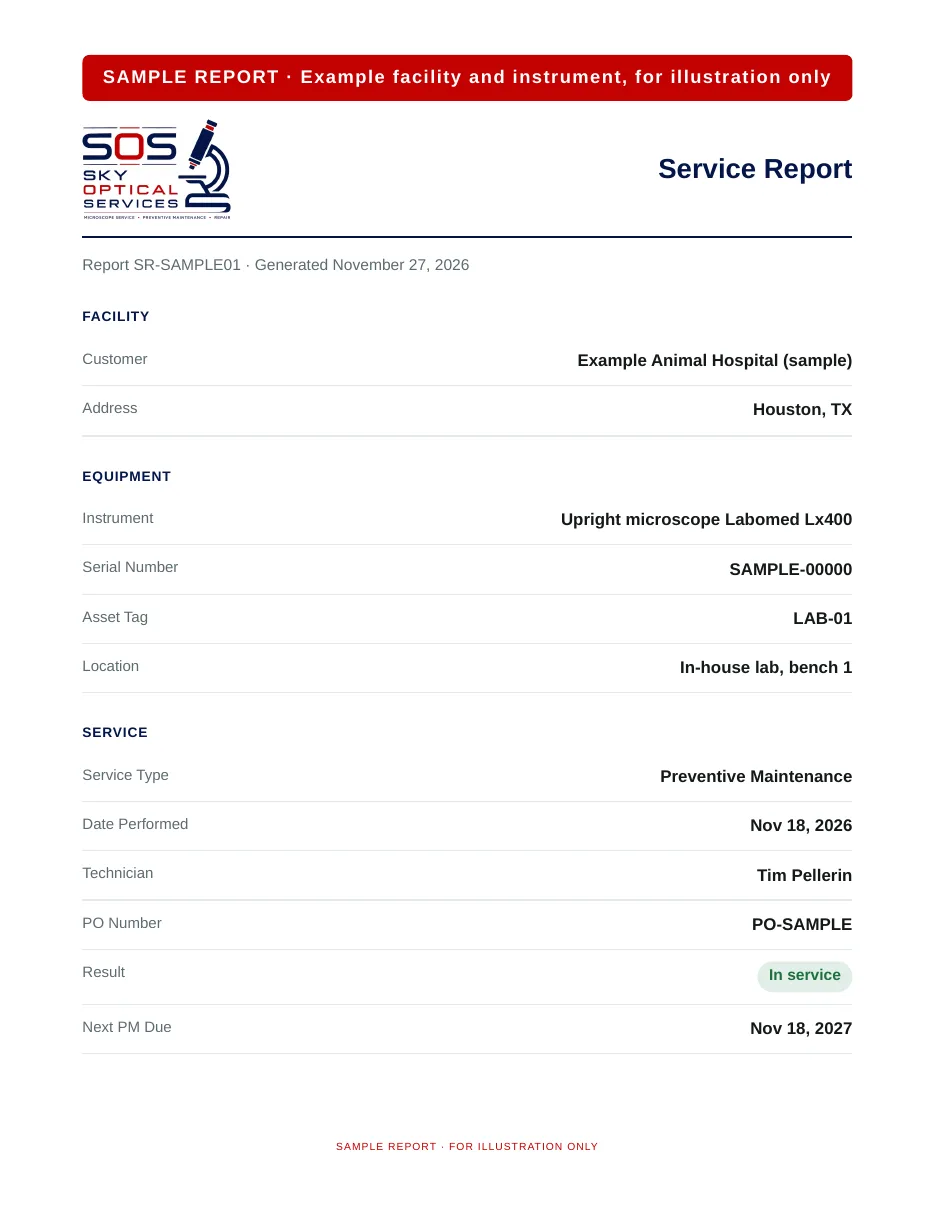
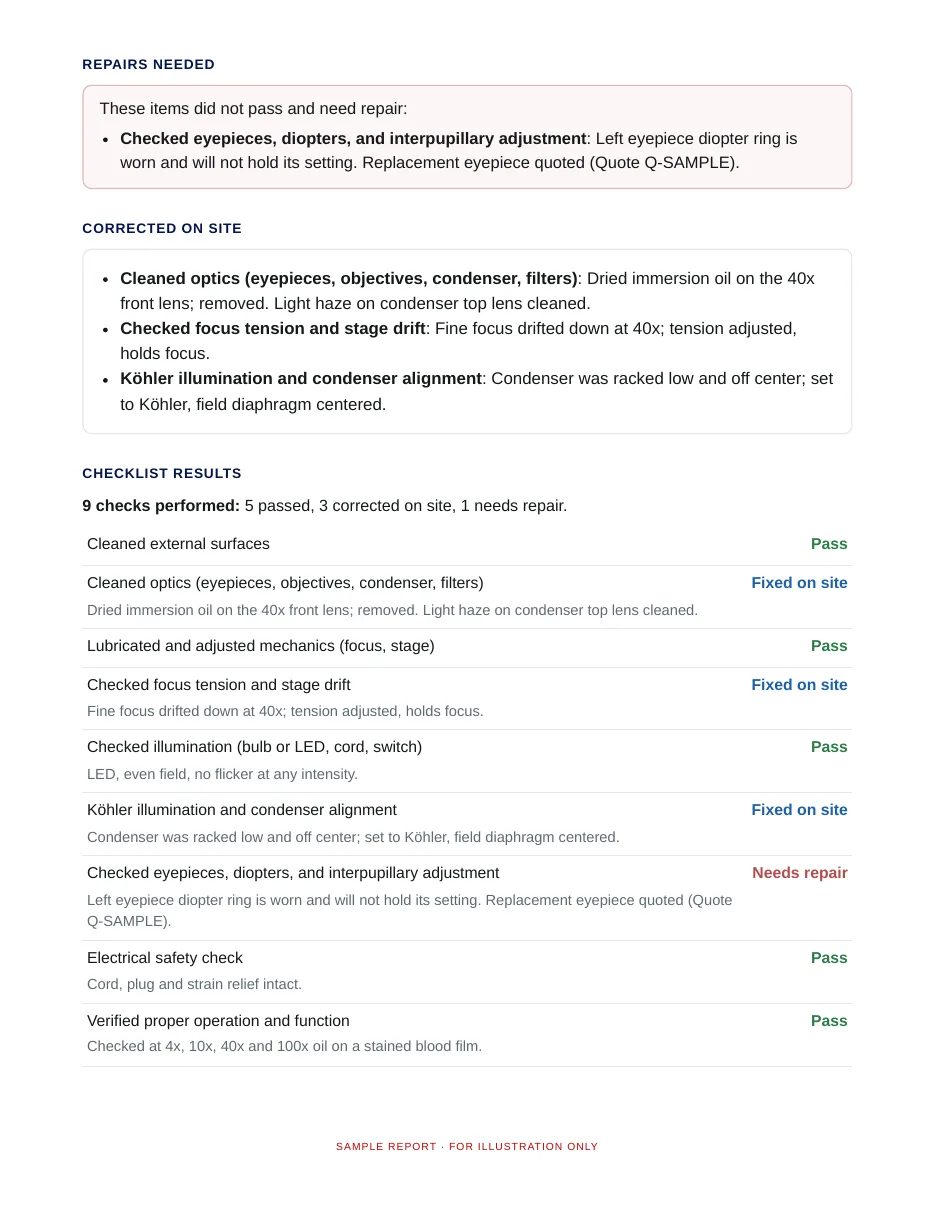
Sample report for an upright microscope at an example animal hospital. Facility, serial and PO numbers are invented.
Download the sample report (PDF)
One report per instrument
Hospitals and labs usually keep service history by instrument, so each microscope gets its own report rather than one summary for the whole visit. Each one lists the facility, the instrument with its make, model, serial number, asset tag and bench location, the service type, the date, the technician, and your PO number if you sent one.
A result for every checklist step
The checklist depends on the instrument. An upright microscope, for example, is checked for clean external surfaces and optics, lubricated and adjusted focus and stage mechanics, focus tension and stage drift, illumination, Köhler illumination and condenser alignment, eyepieces, diopters and interpupillary adjustment, electrical safety, and overall operation. Inverted, stereo, and digital microscopes, slit lamps, colposcopes, and dental operating microscopes each have their own list, and extra steps are added for phase contrast, polarizing, fluorescence, Hoffman, DIC, reticles, multi-head teaching scopes, and cameras.
Every step gets one of four results, with a note explaining anything that was not a straight pass:
What was fixed, and what still needs attention
Anything that needs repair is listed first, in its own box, so it does not get lost in the checklist. Items we corrected on site come next. Then a plain-language summary of the work explains what we found and why it mattered. In the sample, dried oil on the 40x objective and a condenser set too low were washing out contrast on blood films and fecal floats, the kind of slow decline the person at the scope rarely notices.
Status, next due date, and signatures
Each report states whether the instrument is in service, needs repair, or was taken out of service, and gives the date the next preventive maintenance is due. It is signed by the technician and, when available, by a representative of your facility. Reports arrive as a PDF you can print or file in your equipment history, biomed records, or vendor file.
Common questions
Do I get a report for every microscope?
Yes. Each instrument gets its own report, because hospitals and labs usually file service records by instrument. A visit that covers ten microscopes produces ten reports.
When do I receive the report?
Reports are emailed as a PDF with each completed service visit, ready to print or file in your equipment history.
What happens to items marked Needs repair?
They are listed at the top of the report with a note on what is wrong. Nothing is repaired without your approval: we send a quote, and the repair is scheduled once you approve it.
Is the checklist the same for every microscope?
No. The checklist matches the instrument: upright, inverted, stereo, digital, slit lamp, colposcope, and dental operating microscopes each have their own, and steps are added for phase contrast, polarizing, fluorescence, Hoffman, DIC, reticles, multi-head teaching scopes, and cameras.
Is the example report real?
No. The facility, serial number, and PO and quote numbers are invented for illustration. The layout and checklist are the same ones used on every Sky Optical Services visit.
Want reports like this for your microscopes? Send your equipment list (make, model, and quantity) for a preventive maintenance quote.